


Table of Contents
- How to Find Unique Gift Ideas for Art Collectors
- Limited Edition Fine Art Prints: Gifts With Provenance
- Archival and Preservation Tools Every Collector Needs
- Exhibition Catalogs, Art Books, and Curated Reading
- Experiential Gifts: Art Fairs, Studio Visits, and Beyond
- Why Are Art Prints So Expensive, And Why That Matters for Gifting
- Best Practices for Gifting Art to a Serious Collector
- Gifts for the Collector Who Has Everything
Last Updated: August 22, 2026
Finding genuinely thoughtful gift ideas for art collectors is harder than it looks. Most guides point toward novelty items or mass-produced posters, none of which belong in a serious collection. At Filipp Jenikae Art Prints, I've thought carefully about what actually serves a collector: objects with provenance, tools that protect what they own, and experiences that deepen their engagement with art. This guide covers limited edition fine art prints, archival preservation tools, and experiential gifts that most guides overlook.

The throughline is simple: a great gift for a collector adds value to their practice, not just their wall space.
How to Find Unique Gift Ideas for Art Collectors
The biggest mistake most people make is shopping for the aesthetic rather than the collector. Someone who owns original paintings and limited edition fine art prints doesn't need another decorative object; they need something that fits into how they actually live with art.

Start by asking three questions: Does this person collect actively or passively? Do they focus on a specific artistic movement or medium? Do they have dedicated storage and display space?
An active collector building a curated collection will respond differently to a gift than someone who buys occasionally. A collector focused on contemporary art will appreciate a thoughtful exhibition catalog over a generic print. Someone with a growing collection almost certainly needs better archival storage.
The most useful gift ideas for art collectors fall into these categories:
- Works with documented provenance (limited editions, hand-signed prints)
- Archival and preservation tools (acid-free materials, proper storage)
- Knowledge resources (art books, exhibition catalogs)
- Experiential gifts (art fair access, studio visits, conservation tours)
- Studio and display supplies (lighting, framing hardware)
| Gift Category | Best For |
|---|---|
| Limited edition fine art print | Active collectors, new collectors |
| Archival storage supplies | Collectors with growing inventories |
| Exhibition catalog / art book | Art history enthusiasts |
| Art fair tickets or studio visit | Experiential gift seekers |
| Display lighting | Collectors with dedicated gallery walls |
Limited Edition Fine Art Prints: Gifts With Provenance
A limited edition fine art print is one of the strongest gift ideas for art collectors because it carries something most gifts don't: provenance. The edition number, the artist's signature, and the certificate of authenticity transform a print from decoration into a collectible.

The distinction matters. A museum-quality print produced in a numbered edition holds its identity over time. A mass-produced poster does not. When choosing a print as a gift, ask whether it comes with documentation and whether that documentation is handwritten or printed. The difference signals how seriously the artist treats the work.
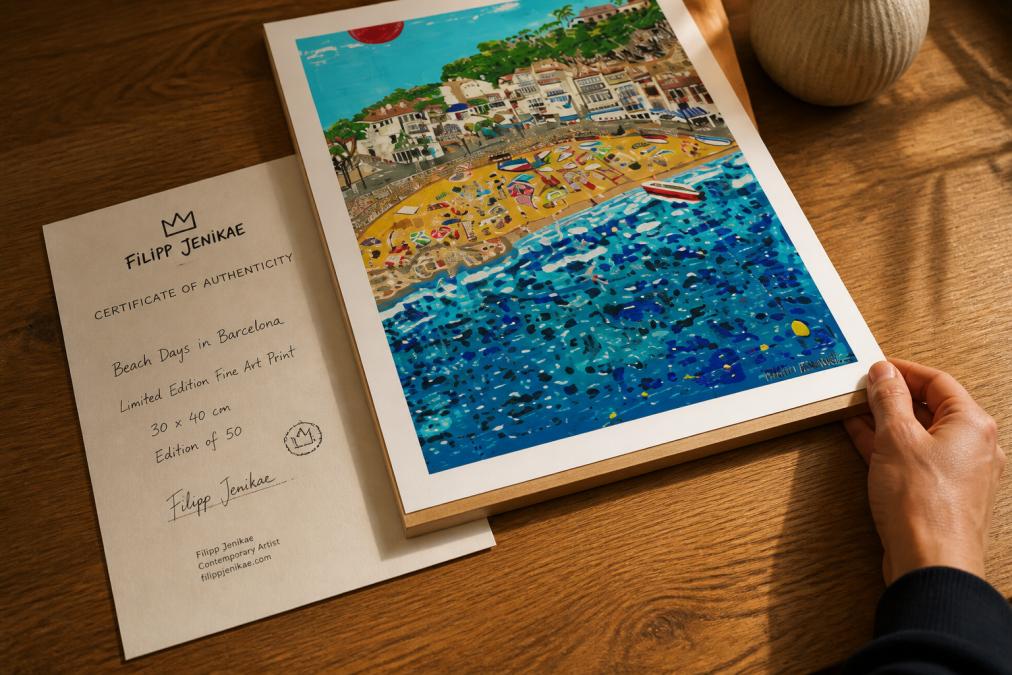
My Limited Edition Hahnemühle Fine Art Print with Handwritten Certificate of Authenticity is designed precisely for this kind of gift. Each print is produced on Hahnemühle FineArt Pearl paper, hand-signed, and delivered with a handwritten certificate. After ordering, we reach out directly so the recipient can choose the specific artwork and size they want.
For collectors seeking a more accessible entry point, the abstract fine art prints in the collection, printed on thick matte paper with archival pigment inks, offer gallery-grade quality. These are museum-quality prints: rich, saturated color that holds over years without fading.
Archival and Preservation Tools Every Collector Needs
Most collectors underinvest in preservation until something goes wrong. A print exposed to UV light fades. A work stored in standard paper sleeves develops acid burn. These are slow, invisible processes, and by the time damage is visible, it's permanent.
This makes archival tools one of the most practical and underrated gift ideas for art collectors. The collector who has everything probably doesn't have a complete archival setup.
Acid-Free Storage and Flat File Cabinets
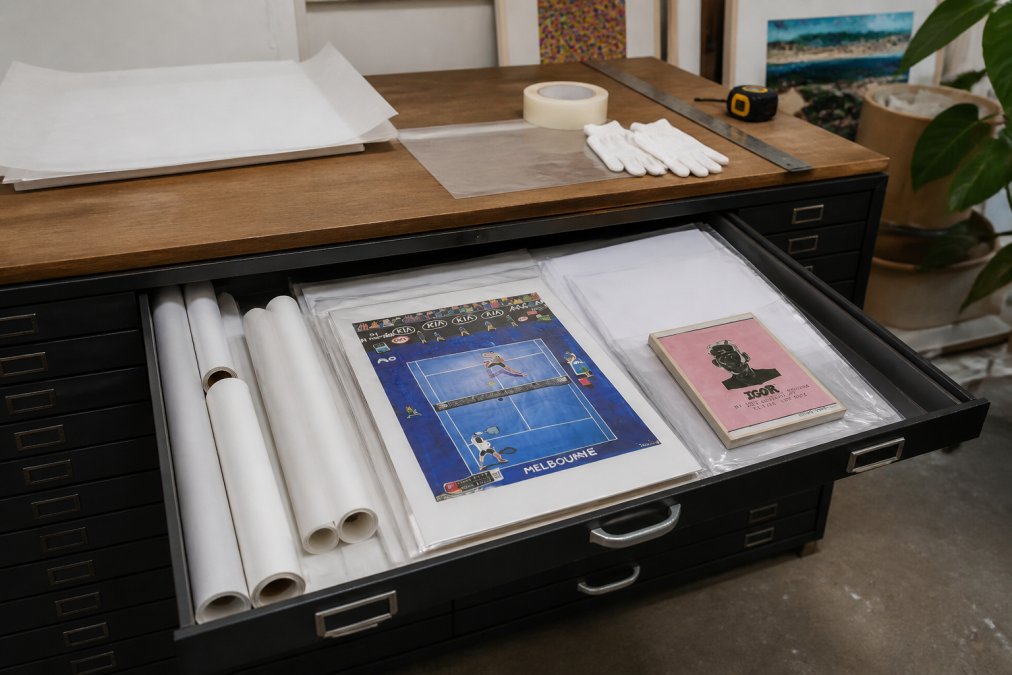
Acid-free storage means housing works on paper in materials that contain no acidic compounds, which degrade paper fibers over time. The standard for serious collectors includes acid-free sleeves, interleaving tissue, and rigid backing boards for unframed works.
Flat file cabinets, wide, shallow drawers designed for storing flat works horizontally, are the preferred solution for collectors with multiple unframed prints. According to the Library of Congress preservation guidelines, horizontal storage in stable environmental conditions is the recommended method for works on paper. A quality flat file cabinet is a significant purchase, but it's the kind of gift a collector will use for decades.
For individual prints, archival polyester or polypropylene sleeves are the accessible alternative. They're inexpensive and immediately useful for anyone building a collection.
Display Lighting and Art Conservation Supplies
Standard incandescent and halogen bulbs emit UV radiation that accelerates fading in fine art prints. LED lighting with low UV output and a color rendering index above 90 is the current standard for gallery-grade display.
UV-filtering glazing, either glass or acrylic, is now standard in professional framing and makes a meaningful difference for works displayed in rooms with natural light. According to the American Institute for Conservation's guidelines for collectors, UV-filtering glazing can significantly extend the display life of works on paper.
A thoughtful gift package might include LED picture lights with appropriate color temperature, a UV light meter for testing existing conditions, and a consultation with a local conservation framer.
Exhibition Catalogs, Art Books, and Curated Reading
Serious collectors read. An exhibition catalog from a major museum show isn't just a souvenir; it's a primary document containing essays, provenance notes, and scholarly analysis that don't exist elsewhere. For a collector focused on a specific artistic movement, a well-chosen catalog is genuinely irreplaceable.
The best approach is to identify the artist or movement the collector follows most closely, then find the most authoritative catalog from a major exhibition. Museum bookshops and specialist art booksellers are the right places to look. The Museum of Modern Art's publication archive is useful for contemporary art catalogs specifically.
Beyond catalogs, consider survey texts on specific artistic movements, monographs on living artists the collector already collects, or art market guides for practical resources on cataloging and valuation. A curated reading list assembled around the collector's specific interests can be more valuable than a single book chosen at random.
Experiential Gifts: Art Fairs, Studio Visits, and Beyond
The most memorable gift ideas for art collectors are often the ones that create access rather than objects. Collectors who have been buying for years have seen many objects. What they haven't necessarily had is a behind-the-scenes experience.
Art fair tickets are the obvious starting point. Major fairs bring together galleries, artists, and works that don't appear elsewhere in one concentrated context. VIP preview tickets, which typically offer access before the general public and often include curator-led tours, are genuinely distinctive gifts.
Studio visits are rarer and more personal. Many artists, particularly those earlier in their careers, welcome collectors into their working spaces. The experience of seeing where and how work is made changes how a collector understands the finished pieces they own.
Other experiential options include private gallery tours led by a curator, art conservation workshops, collector circles hosted by museums, and auction preview access where works can be examined up close before sale.
Why Art Prints Vary in Price, And Why That Matters for Gifting
Art prints vary enormously in price, and the reasons aren't always obvious to someone outside the collecting world. Understanding the difference helps you choose a gift that a collector will actually respect.
A fine art print is expensive when it is:
- Produced in a limited edition with documented provenance
- Printed on archival paper (such as Hahnemühle) using pigment inks rated for long-term stability
- Hand-signed by the artist
- Accompanied by a certificate of authenticity
- Produced by an artist with an established exhibition history
A print that meets these criteria is a collectible. One that doesn't is decoration. The price difference reflects that distinction directly.
This matters for gifting because it determines how the recipient will receive the work. A serious collector who receives a mass-produced print will recognize immediately that it isn't a collectible. A museum-quality limited edition fits naturally into their collection.
The abstract fine art prints available through Filipp Jenikae Art Prints are produced with archival pigment inks on thick matte paper to meet this standard. The hand-signed limited edition adds documented provenance and personal correspondence with the artist.
Best Practices for Gifting Art to a Serious Collector
Gifting art to someone with a developed aesthetic sensibility carries real risk. The best practices here reduce that risk considerably.
Don't assume taste. A collector with a focused, curated collection may not welcome a work outside their established aesthetic, even if it's objectively excellent. When in doubt, give them the choice: a gift certificate, a consultation process, or a print selected collaboratively.
Prioritize documentation. Any work gifted to a serious collector should come with full provenance documentation: edition number, paper type, artist's signature, and certificate of authenticity. Collectors catalog their acquisitions, and a gift without documentation creates administrative work.
Consider the display context. A large-format print is meaningful only if the collector has wall space for it. A smaller work or one with framing options is often more practical.
Think about condition. Works should arrive in pristine condition, properly packaged. According to professional art shipping standards from the Fine Art Shippers association, proper packaging is one of the primary factors in condition on arrival.
Gifts for the Collector Who Has Everything
The collector who has been buying seriously for a decade presents a specific challenge. They've seen most of what's available and have strong opinions.
The most effective gift ideas at this level tend to be either exceptionally personal or genuinely functional.
Genuinely personal options:
- A commission or bespoke work from an artist they admire
- A work by an emerging artist they haven't yet discovered, chosen with curatorial care
- A hand-signed limited edition from an artist whose work they've followed but not yet collected
Genuinely functional options:
- A flat file cabinet or archival storage system, particularly if their collection has grown beyond current storage capacity
- A professional art inventory and cataloging service for documenting provenance and condition
- Museum membership at an institution aligned with their collecting focus
The KAMA3 x Beton and Circle Sculpture MX34E prints from this collection occupy an interesting position for this kind of gift: they're artist-created contemporary works with distinct visual identity, not generic wall art. For a collector whose holdings lean toward abstraction and urban aesthetic, they introduce a voice they may not already have represented.
A genuine gift for an art collector respects their seriousness. It doesn't try to decorate their life; it adds to their practice, protects what they already own, or opens a door they haven't walked through yet. The Filipp Jenikae Art Prints collection, from museum-quality prints to hand-signed limited editions with full provenance documentation, is built with exactly that kind of collector in mind. Browse the collection and reach out directly if you'd like help choosing something specific for the person you're gifting.
Frequently Asked Questions
What do you buy someone who collects art?
The most thoughtful gifts match the collector's existing taste rather than guessing at new directions. Strong options include limited edition fine art prints from an artist they already follow, archival storage supplies like acid-free sleeves or flat file cabinets, exhibition catalogs from significant shows, or experiential gifts such as art fair tickets. If you know their collection well, a hand-signed print with a certificate of authenticity is a genuinely collectible addition rather than a decorative afterthought.
Is it better to gift an original painting or a limited edition print?
For most collectors, a limited edition fine art print from an artist with verifiable provenance, hand-signed, numbered, and accompanied by a certificate of authenticity, is a more practical gift than an original painting. Originals carry higher price points and require the giver to know the recipient's taste with precision. A limited edition print still carries artistic legacy and collectible value, but at a range that suits gifting. The key detail is edition size: smaller runs hold more significance for serious collectors.
Are fine art prints considered good gifts for collectors?
Yes, when they meet gallery-grade standards. A museum-quality fine art print produced on archival paper with pigment inks, hand-signed by the artist, and accompanied by documented provenance is a legitimate collectible. What separates these from generic posters is the production process, the artist's direct involvement, and the edition structure. Collectors who already own originals often welcome prints from artists whose originals are outside typical gift budgets, it's a meaningful entry point into a body of work.
How do you choose art as a gift for a collector without getting it wrong?
Start with what you already know about their collection: the artistic movements they favor, the medium, the color palette, the subject matter. Avoid buying art in a style that doesn't appear anywhere in their existing collection. If you're uncertain, archival tools, art books, or experiential gifts are safer choices that any collector will appreciate. When you do buy art, prioritize works with clear provenance, a hand-signed piece with a certificate of authenticity removes ambiguity about its status as a collectible.
How can I support a contemporary artist through gifting?
Buying directly from the artist or their official store is the most direct form of support. It keeps more of the sale price with the creator rather than a third-party platform. Gifting limited edition prints, sharing the artist's work with other collectors, and writing genuine reviews all contribute to an artist's visibility and market presence. For contemporary artists working across original paintings and fine art prints, each purchase helps sustain the studio practice that makes the work possible.


